
Services
Testing Laboratory
Application of MFC to the surface of paper and board using wet lamination technology in the laboratory
Towards recyclable cellulose-based barrier packaging materials
- Enhancing the barrier properties of paper/cardboard through MFC coating
- Production of A4 sheets
- Performance evaluation based on MFC grade
- Barrier property characterisation
General informations
The wet lamination of MicroFibrils of Cellulose (MFC) is a unique process developed and patented by CTP that enables paper or cardboard to be bonded without adhesive to a thin layer of MFC, thereby imparting barrier properties and increasing their rigidity, whilst preserving the paper’s biodegradability and recyclability. This process enables the creation of packaging barrier to grease and oxygen. It can be combined with a coating step to impart water and water vapour barrier properties whilst remaining compliant with regulations. This solution offers an alternative to aluminium for high-barrier packaging and helps reduce the amount of plastic used and CO2 emissions associated with producing such packaging.The CTP’s laboratory equipment enables the production of A4-sized samples to provide proof of concept and validate the approach and the performances achieved.
Thin MFC films can be laminated onto different types of paper/cardboard with varying grammages and weights.
Technical Data and Achievements
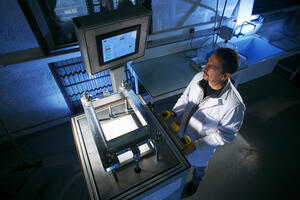
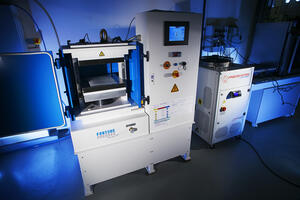
Laboratory equipment for wet lamination of MFCs
This laboratory-scale equipment enables A4 sheets to be laminated with MFC in three stages:
- Filtration of the MFC suspension through a membrane to form the wet MFC film. This is a standard papermaking filtration process.
- Transferring the MFC film onto the paper/board substrate, followed by a pressing stage in a platen press.
- Drying on a flat dryer.
Evaluation of substrates and MFCs
The CTP teams can evaluate the characteristics of paper/cardboard substrates and MFC suspensions prior to wet lamination. Substrates and MFCs can be supplied by the CTP.
Preparation/post-treatment of substrates
The CTP teams can prepare the substrates in advance (pre-coating, plasma activation, calendering) or apply an additional surface treatment (coating, chromogeny grafting).
Evaluation of the materials formed
- Barrier properties
* Oxygen barrier: Oxygen transmission rate (OTR) under variable climatic conditions in accordance with ASTM D3985, ASTM F1927 and ASTM F2714.
* Grease barrier: Oil absorption capacity of the material using the Cobb method in accordance with standard SCAN-P37, test kit in accordance with standard ISO 16532-2, tests with palm oil (ISO 16532-1) and turpentine (ISO 16532-3), Cobb test with MCT oil (NF Q03-017).
* Contaminant barrier. - MFC layer adhesion
The delamination resistance of the MFC layer on paper/cardboard can be assessed using 180° or 90° peel tests in accordance with various standards. - Other mechanical properties.
- Recyclability/biodegradability.
The material can be used to produce MFC films.
 |
 |
|
| MFC filtration | Lamination onto substrate and pressing |
Also to be seen
Consultancy Diagnosis
Centre of Excellence
Trainings
Pilots
Collaborative projects