
Means
Pilots
The MFC wet lamination pilot
Coating MFC onto paper and board for barrier and recyclable packaging
- Developing materials for the packaging and speciality paper sectors
- Applying an MFC film to the surface of paper and board
- Improving the barrier properties of paper and board whilst maintaining their recyclability
The little story of the pilot
What at first glance appeared to be a failed laboratory experiment, an unexpected result, led to the concept of wet lamination being born in 2014.Since then, the teams at CTP have worked tirelessly to validate the concept, file a patent, secure funding, design and build a dedicated laboratory machine, and then devise and sketch out a pilot project. This pilot, one of a kind and custom-built, arrived at the CTP in late 2019.The concept involves applying a layer of MFC to the surface of paper or board to improve its barrier properties against grease, oxygen and contaminants. This process is an original approach based on conventional paper-making equipment. Patented several years ago, it has recently benefited from major technical advances, bringing it closer to industrial conditions.
The application of MFC at pilot scale is dedicated to validating the concept in continuous operation and to the production of sample reels.
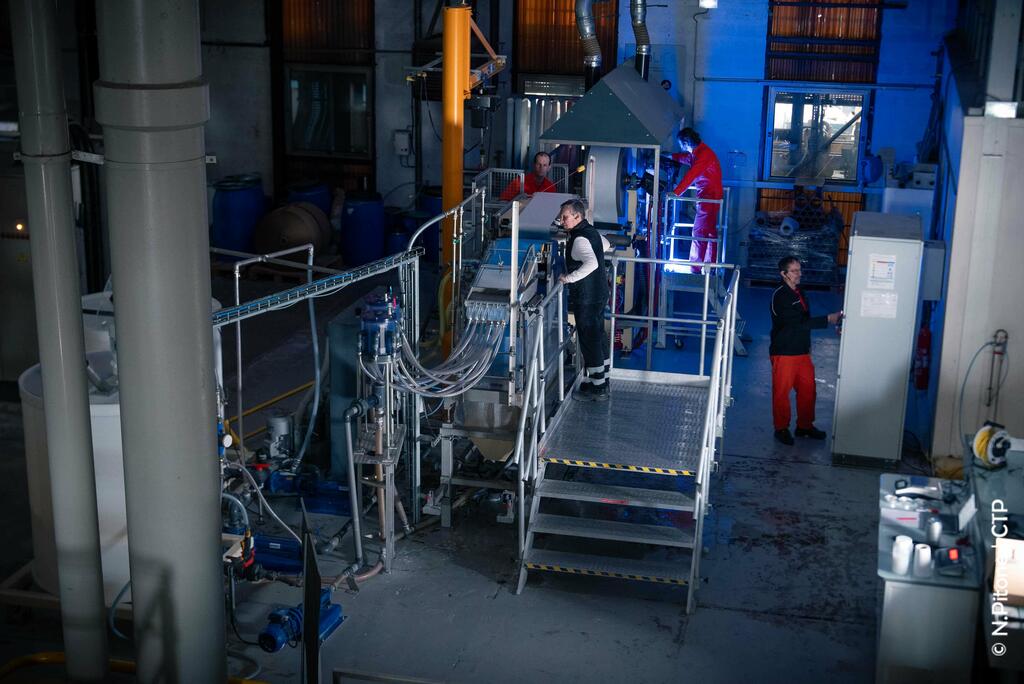
Description of the pilot
MFC wet lamination technology is based on three stages:- Production of a wet MFC film using a conventional papermaking filtration process
- Using a double-jet headbox, the MFC can be filtered with excellent retention onto a thin layer of fibres
- Transfer of the wet mat onto a dry paper/cardboard substrate
- Drying on drying cylinders
Technical characteristics
- Speed: 3 to 10 m/min
- Fibre feed tank: 1 m³
- MFC feed tank: 1 m³
- Useful forming width: 305 mm
- Several wires available
- 3 independent vacuum areas
- Reel width: 305 to 360 mm
- Reel diameter: 50 cm maximum
- Replication calender
- 3 drying cylinders, 80 cm diameter
- Max surface temperature of drying cylinders: 180°C
- Maximum vacuum: 400 mbar
- Paper grammage: 50 to 300 g/m²
- Maximum reel weight: 60 kg
- Maximum linear load: 15 kN/m
- 2 independent oil heating units
- Suspension flow rate: 6 l/min maximum
- Inclined plane former
 |
|
Facility acquired in the frame of the MaLics platform with the support of the Auvergne-Rhône-Alpes regional council |
 |
Also to be seen
Consultancy Diagnosis
Centre of Excellence
Testing Laboratory
Trainings
Platforms
Collaborative projects