
Circular-C (2025-2029)
Novel biobased formulations for CIRCULAR Construction materials
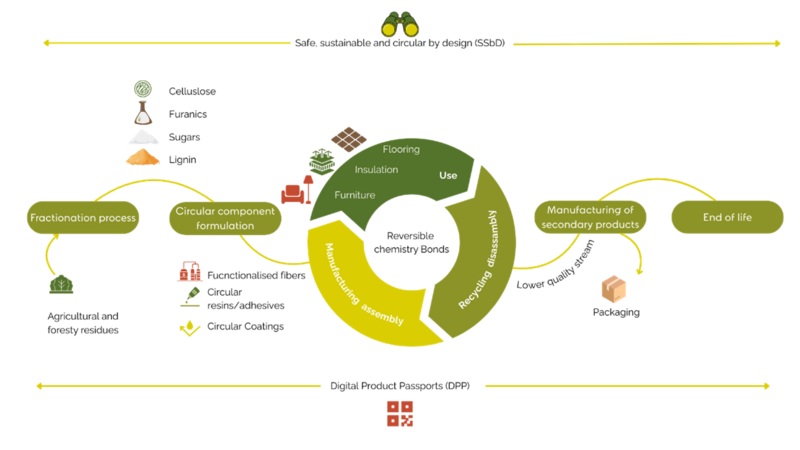
- Biorefining of mixed sustainable biomass residues
- Producing high-strength functionalised cellulosic fibre material and circular adhesives and coatings with high biobased content and reversibility
- Producing formulations in construction panels and their targeted disassembly
- Developing Digital product passport as part of Safe & Sustainable by design (SSbd) strategy
Aim of the project
CIRCULAR-C is a EU project aiming to develop a new generation of circular, sustainable, and biobased adhesives, coatings, and functionalised fibres at TRL 5. These new formulations for wood panel construction (used in flooring, furniture, and insulation) featuring reversible chemical bonds and Digital Product Passports enhance recycling and reduce environmental impact.Along with the technical processes, the project will deploy DPPs to ensure full traceability and lifecycle management.
Our long-term impact by 2038, calls to operate a fully scaled CIRCULAR-C plant with an annual output of 10.8 kt of adhesives, 12 kt of coatings, 50 kt of functionalised fibres and 15.3 kt non-PU foams, which could be potentially used in 75,000 residencies. This venture is expected to generate €114 million in revenue and sustain 381 full-time jobs while cutting the use of hazardous chemicals by over 75% and reducing 80 -100% GHG emissions to achieve climate neutrality by 2038.
Emphasising design for circularity and the strategic utilization of renewable resources is crucial for unlocking the complete benefits of a circular economy in the construction manufacturing sector. In this context, biobased adhesives, coatings and functionalised fibres are pivotal for enabling circular and sustainable construction products. However, the predominant reliance on fossil-based materials, hazardous chemicals and the challenge posed by non-debondable adhesives and coatings significantly hinder the recycling process, detracting from the value of recyclable materials. Therefore, the shift towards maximising the valorisation of residues and reuse of materials, as well as innovating new biobased materials stands as a cornerstone for transitioning to a more sustainable, biobased circular economy.
Our consortium, consisting of top-tier EU and global industrial leaders in biobased chemical and construction (Chimar, Soprema, KEAS), cutting-edge private sector experts in Digital Product Passports and Exploitation (Amodamo, Steinbeis), and world-renowned RTOs (TNO, VITO, Fraunhofer, CTP, VTT) covering the entire value chain, will successfully reach TRL 5 through a highly structured, dual-pillar approach, ensuring both technological and market advancements. The funding of the CIRCULAR-C will have the following impacts :
- Enhance circularity by enabling safe reuse and reassembly of construction materials through reversible chemical bonds and DPPs. This approach increases resource efficiency (at least 3 times reassembly of products), minimises environmental impacts (80-100% greenhouse gas emissions and 75-100% hazardous material reduction), and guarantees product transparency, empowering consumer choices and fostering societal trust in biobased innovations. Drive innovation through the integration of reversible chemistry and DPPs. This advancement will significantly advance the biorefining industry, offering novel cost-effective pathways for residual biomass valorisation, material utilisation, and lifecycle management. By 2038, it will generate 114 M€ in revenues and 381 jobs.
- Meet the manufacturers’ dual objectives of adhering to tightening regulatory requirements and fulfilling customers’ expectations for safer, more sustainable, and longer-lasting products while promoting supply chain independence to address evolving market challenges.

 |
CIRCULAR-C is an EU Funded project with 4 M€ founding for a period of 4 years and started in June 2025. Funded by the European Union under grant agreement 101181766. Views and opinions expressed are however those of the author(s) only and do not necessarily reflect those of the European Union or the European Innovation Council. Neither the European Union nor the granting authority can be held responsible for them. |